1. In 1Dial needle B moves 1/12 the Dial Distance (DF). Needle R move 1 full Dial Distance (DF).   And travels 100.5 mm (32mm x 3.1416 = 100.5312 ≈ 100.5mm) on the Distance Piece which represents 1669.7916 km moved by the Equator. Using here 1/12 Dial Distance (DF) moved by Needle B =1/12 Dial distance (DF) as D F1/12 i.e. Needle R= 1Dial Distance (DF) as DR (=1Basic {B}) we have the speed of:
  1. Car W’s Speed = 20Chkm/(DFR-60) which would read as 20Chkm per Dial (DF) (full Dial Travel  by Needle R)  If this Speed is constant & has a definite Direction then it would be Car W’s Velocity =20Chkm/DFR-60.
  2. Car Y’s Speed=40Chkm/DFR-60 which would read as 40Chkm per Dial (DF) (full Dial travel by needle R) If it is constant & has a definite direction then speed becomes Car Y’s velocity =40Chkm/DFR-60.
  3. Car Z’ Speed =60Chkm/DFR-60 which would read as 60Chkm per Dial (DF) (full Dial travel by needle R) If it is constant & has a definite direction then Speed becomes Car Z’s velocity =60Chkm/DFR-60.

Here we see that the Speed/Velocity of Car W is ½ of Car Y and 1/3 of Car Z.


Needle P moves DFP-1 of DFR-1/60 the Dial which is 1P and matched to this the distance travelled by the Equator is = 1Chkm.  For further explanation of Needles P, R & B Movements see Page 21, Fig.11.

A Body which starts with a velocity of 3Chm/P and Travels with an acceleration of 2Chm/P2 (Chm /P/P = Chm/P2) for 4 P’s. At the end of the 1st P, 2Chm/P is added to 3Chm/P and the body at the end of the 1st Portion attains the velocity of 3Chm/P + 2Chm/P = 5Chm/P. As such, Velocities attained by the body starting with an original velocity of 3Chm/P and travelling with an Acceleration of 2Chm/P2 for 4P’s would be as shown below-

Starting Velocity of 3Chm/P.   Acceleration 2Chm/P2 for 4P

At the end of  1st   Portion  3Chm/P +2Chm/P=5Chm/P

At the end of  2nd   Portion   3Chm/P+ 2Chm/P+2Chm/P=7Chm/P

At the end of  3rd   Portion   3Chm/P+ 2Chm/P +2Chm/P +2Chm/P = 9Chm/P

At the end of  4th   Portion  3Chm/P+   2Chm/P + 2Chm/P+2Chm/P +2Chm/P=11Chm/P                                                                                                      

So we have Acceleration  according to the  New Concept which  is =  Chm/P2

and  we know   Force  =Mass x Acceleration   or F = M x  Chm/P2              

Work = Force x Distance ; W=F x D ;  W = ( M x Chm/P) x D ; And the Capacity  to do     Work is Energy and Mechanical Power as – Horse Power ( H. P.)

( Metric- “ Pferdestaerke “) 1PS =  75kpm/s  ( i.e. 75kp x 1m) ¸1s

would become according to the new concept -75kpm/P = 75kp . m / P

kp x  Chm  x 75 ¸ 0.463831/P    =  161.69682   kpChm/P

( Metric New Concept )   1PSNC » 162 kpChm/P  

Needle movements on Distance Piece.

See Fig.7, page 14. We have Chosen a Diameter =19.1mm which multiplied by 3.1416 gives us 60mm Circumference. These Dials (DF)with their respective Needle movements have been shown below  i.e.
CONVERSION

We have converted normal Km to Chotu Km which are 0.463831 of the normal kilometer length but we have not converted time to distance or vice versa. We have kept the divisions distance the same 24 x 60 x 60 (for easy understanding) whereas we could very well have kept them as 25 x 40 x 40 (See Page 11) and 28 x 70 x 70 divisions (See Page 26).

Note 10:                

Now we take the distance piece with a dial diameter of 35.4 mm and a circumference of 111.3 mm (See Page 15 Fig 8) and place it within a spiral (See Page 33 Fig 18) giving 00000 to 43200 Chkm for the inner (i.e. ½ L = E) and 43200 to 86400 for the outer (i.e. up to 1L = 2E). Therefore we have 1L divided by 2, which is equal to 1 E, 1E divided by 12 we get 1B (43200/12 = 3600 Chkm), 1B divided by 60 = 1 R, 1R divided by 60 we get 1P.

From Page 16, see fig.9 G-G’ we see 60p x 12 = 720 = 1M (M = 1Measure), 720 x5

= 3600 P or [720×5 = (60×12) x5 = 60 x 12 x5 = 60 x 60] = 3600P and also 3600P x 12
= 43200 Chkm.

            Therefore   1 L             = 86400 Chkm

                              1E              = 43200 Chkm

                              1B              = 3600 Chkm

                              1 M            = 720 Chkm = (60 x 12 Chkm)

                              1 R             = 60 Chkm

                              1 P             = 1 Chkm

                              1R x 1M    = 60 Chkm x (60 x 12) Chkm = (60 x 60 Chkm) x 12

                                                = 3600 Chkm x 12 =1 E = 43200 Chkm, and

                                                    2 x E = 2 x 43200 = L = 86400 Chkm.

Earth’s ORBIT around the Sun ES Moon’s Orbit around the Earth = M

Speed, Velocity and Acceleration

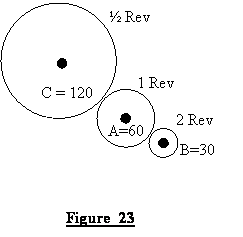
  1. Let us think of 3 teethed (gears) wheels in mesh with each other such that(See Fig.23.)Wheel A has 60 teeth, Wheel B 30 teeth and Wheel C 120 teeth .It is clear that when Wheel A makes a complete Revolution all its teeth move i.e. its 60 teeth move 60 teeth out of 120 teeth of Wheel C which means 60/120 = ½. So when A Revolves 1 full Revolution, C Revolves only ½ a Revolution i.e. the speed of the Axle of C is ½ that of the Axle of Wheel A. Similarly A:B=60:30=2 Which means Wheel B’s Axle has twice (2=double) the Speed of WheelA’sAxle. This also holds good for Automobiles (and other Machinery), which run with Gear (Teethed) Wheels i.e. [Gears do not permit slippage, which is also possible with teethed Belts and Gears – the same relationship as above for Gears A, B & C would hold good] So it is clear from the above that “Speed is a Distance to Distance Relationship”.

Frequency is number of oscillation = O = (2 x A) per second. We have already explained that there is no such thing as time there is also no such thing as a second. Frequency would therefore be the number of complete oscillations per Portion (P). (i.e. 1/60 of Needle P’s Complete Dial Revolution) (See Page 14 Fig. 7)

Energy – is dealt with later on in this Book See page 47.Looking above paragraph 2, it is stated that by using the Cesium Clock (Distance Piece) the time intervals can now be measured with an error of not more than one second in 3000 years. But as there is no such thing as time, according to the new concept the Cesium Distance Piece (Clock) would measure distance intervals with error less than one Portion (P) in 3000 Orbit (O).

Cycles: A cycle is also a distance i.e. a particle starting at one point oscillating and coming back to the same point.

Now that the subject has progressed considerably we would like to deal with these advancements in accuracy. On the Discovery channel it was mentioned that a laser beam is bounced off a reflector (Left behind by the astronauts) left on the Moon which was being used to measure the time interval of a day and that the world was slowing down and losing a second per 86400 seconds. The truth of the matter is however that it is traveling 1P = 1Chkm less per each revolution of 86400 Chkm i.e. distance traveled each length (L) [Day] is decreasing.

The basic unit of Time till 1967 was (1/60) (1/60) (1/24) = 1/86400Th of the average Solar day. In 1967 – the Atomic clock was introduced, which used characteristic Frequency of the Cesium – 133 atom as a reference clock. The second is now defined as 9,192,631,770 (Times the) period of one oscillation of the Cesium atom. (See Page 43 Remark A)

According to the dictionary, the definitions of the above words are as below:

  1. a)Characteristic  :           Distinguishing feature or quality
  2. b)Frequency      :           Number of time a wave repeats itself in a given time
  3. c) Period             :           Particular portion of time
  4. d)Oscillation       :           Swinging back and forth

We notice that neither does 1) characteristic i.e. distinguishing features or qualities nor 4) oscillations i.e. swinging back and forth (has anything to do with distance or Time). So we are only to consider 2) Frequency and 3) Period.

  1. Frequency: Here we could say how many occurrences a wave has in a given time. We however know that there is no such thing as time but a distance interval on the dial (DF). So we may say that how many occurrences of a wave as shown on a distance piece (DF) i.e. the distance moved by any of the needles B, R or P or a fraction of this distance interval moved by them.
  1. Period: is defined as a particular portion of time. Here again, as above, the truth is that it is a   particular portion of a distance as time is our own imaginary creation and does not exist.

In any case even if it were accepted that time be used as a substitute for distance, it must be remembered that time is a function of distance (See Page 68) as already explained on Page 8. If the Earth stops rotating, then there will be eternal Light on the side of the Earth facing towards the Sun and Darkness forever on the opposite side of the Earth; as a result there would be no 24 hr. 60 Mts. or 60 sec. i.e. Time ceases to Exist although the Distance of 40075 km would continue to exist for eternity.

It is very clearly explained in this book that TIME AND SPACE DO NOT EXIST -ONLY DISTANCE EXIST. The question of eliminating something that does not exist cannot arise.

Digital Time Pieces:

The way in which digital time pieces work is dependent on the movement of gears. These are also distance to distance relationships. See page 46, Fig. 23. The so called digital time piece would be in reality Digital Distance Piece.  It does not matter if the time Pieces ( DISTANCE PIECES ) have numerals instead of  Needles because these  Numerals will only show the number of Basics, Ranges and Portions which represent  the movement  of the Earth’s Equator. Please see Page 37, Fig.  20 (Note numerals have been used on the Earth’s Equator to express Basics and Ranges.)

Cesium-133 Atomic Clock: (From ordinary level Physics P. N. 11 – 12)

Quote out of Physics Book “Quartz clocks are themselves checked by cesium atomic clock at the national physical laboratory. Atomic clock is too complex a device to be described in detail, but briefly it is a radio transmitter giving out short waves about 3 cm long, the frequency of which is controlled by the energy changes in the gaseous cesium atom. The great advantage here is that the frequency (i.e. the number per second) of the changes is constant and not subject to error.”

“By using cesium clock, time intervals can now be measured with an error of not more than one second in 3000 years!. This is so much better than the results obtained by astronomical observations alone, so in 1967 a second was redefined as the time interval occupied by 9,192,631,770 cycles of a specified energy change in the cesium atom.” (See Page 43 Remark A)

A transverse wave is seen when one end of a piece of rope or string is moved up and down in a direction perpendicular to its length. The particles of the rope near the end exert a drag on their Neighbors, so that these begin to oscillate as well. The number of complete oscillations made in one second is called the frequency (f).(See Page 43 – Time)

Remark:

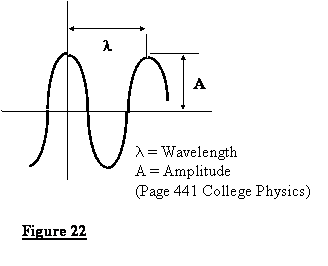
Looking at the highlighted words above. An illustration of a wave is given in Fig. 22,. In the case of the cesium clock l is 3cm long. which consists of a wavelength (l) and amplitude (A), which are both distances. In   case of the cesium clock l is 3 cm long.

to each other) or even length, breadth, height which again are three Distances at some angles to one another. Even Angles are Distances.

From 2.  Interval between Points – Clearly indicates Distances, Objects according to the three Dimensional Co-ordinate system are discussed on Page 48, Fig. 24

TIME (“From College Physic Book”)

Before 1960, the standard of time was defined in terms of the average length of a solar day for the year 1900. (A solar day is the time interval between successive appearances of the sun at the highest point it reaches in the sky each day.) The basic unit of time, the second, was defined to be (1/60) (1/60) (1/24) = 1/86400 of the average solar day. In 1967, the second was redefined to take advantage of the high precision obtainable with a device known as atomic clock, which uses the characteristic frequency of the cesium-133 atom as the “reference clock”. The second is now defined as 9,192,631,770 times the period of one oscillation of the cesium atom.

  1. A)REMARK

Further to the definition of time given above which states “the basic unit of time the second was defined to be 1/86400 of the average Solar day.” Which is the definition of a second a unit of time which is not acceptable, as time doesn’t exist.

However, taking the same divisor 86400 for maintaining the same scale and for the sake of simplicity,we divide the distance of the Equator revolved in front of the Sun in one solar day which is 40075 kms by 86400 and get a Portion having a distance of 0.463831 Kms moved by the earth’s Equator in front of the Sun, which would therefore accommodate 9,192,631,770 oscillations (Swinging back and forth) of the Cesium Atom Device. The error in an Atomic Device is expected to be within one Portion(0.463831kms)in 5000 Orbits. This is accepted only temporarily as further development like the Hydrogen Maser gives promise of Distance accuracies of the order of one Portion (0.463831 Kms)in 33million Orbits. One Portion being a Distance of 0.463831kms and one Orbit being also a Distance of 960,000,000 Kms and these both being Distances, as such they are in a Distance to Distance relationship and there is no such thing as Time. Please also refer to other examples of “Distance to Distance Relationship” on page 3.

  1. B)REMARK

Time and measure of time are very clearly defined above and there is no confusion. However this book emphasizes that there is no such thing as time and as such, the question of its measure does not arise. Therefore the consistent usage of time as a unit of measure does not arise. Regarding using the equatorial circumference as the basis for the Chotu Kilometer in preference to the present meter which is 1/10,000,000 of the distance of the equator to the north pole is that, this distance travels in front of the sun in bright sunlight and darkness when divided into 24 x 60 x 60 equal to 86,400 parts, giving us a better decimal free division by Chotu kilometer having a length of 0.463831 of a normal Kilometer which is very suitable for transferring distances from the Earth’s Equatorial Circumference to our distance piece. Sure the meter is still a meter whether it is 1/10,000,000 of the distance from the North Pole to the equator or   it is redefined (Or re-measured more accurately) as the “distance travelled by light in vacuum during a time of 1/299,792,458 seconds”.  In effect, this latest definition establishes that the “speed of light in vacuum is 299,792,458 meter per seconds”.  In a similar manner you may say that the Kilometer is redefined as a Chotu Kilometer  which is   1/86400 of the Earth Equatorial Circumference (travelled) instead of being 1/10,000 (Kilometer) part from the north pole to the equator. The Chotu Kilometer/ meter is also re-definable   by the speed of light, taken as   Chotu meters per ‘portions’.( and not meters per ‘second’ ) .And the Speed of Light in vacuum would be given as 299,792,458 ¸ 463.831 Chotu meters  per ‘Portion’ .

Regarding DISCOVERY: A discovery does not necessarily mean that it is something new as discovery can also mean the proper understanding of something very very old. For instance, millions of apples had fallen before Newton was able to get a proper understanding of gravitation. It does not mean that other Physicist before Newton had not seen an apple fall and did not know that if they let go of an apple it would not fall to the ground. It was a discovery because he got the proper understanding about the law which governed the falling of the apple. The author of this Book claims this to be a discovery i.e. TIME & SPACE DO NOT EXIST- ONLY DISTANCE EXISTS, as no other person has stated  very clearly earlier the non-existence of time and space. There is no record of anybody having thought about this and DECLARED i.e.  having made known this new concept before now.

It is therefore clear that time is   used as a substitute distance and not distance as a substitute for time. As a matter of fact, we do not need this imaginary, fictitious thing called time. We can do very well without it and express distances moved from the equatorial circumference to the distances moved on our distance pieces and get the same if not better results. In this book, it is not that time is being expressed as distance, but that a distance to distance transfer is possible without the introduction of this so called imaginary Unit Time. Further, changing units of time to the unit of kilometers would only be possible if there had been such a quantity as time, in other words you cannot change units of nothing to units of somethingElimination of time would have been possible only if time existed as one cannot eliminate something which does not exist.

LENGTH (“From College Physic Book”)

In AD. 1120 the king of England decreed that the standard of length in his country would be the yard and that the yard would be precisely equal to the distance from the tip of his nose to the end of his outstretched arm. Similarly, the original standard for the foot adopted by the French was the length of the royal foot of King Louis XIV. This standard prevailed until 1799, when the legal standard of length of France became the meter, defined as one ten millionth of the distance from the equator to the North Pole (See Page 12, Fig. 6)

There have been many other systems developed in addition to those discussed above, but the advantages of the French system have caused it to become the prevailing system in most countries and in scientific circles everywhere. As recently as 1960, the length of the meter was preserved as the distance between two lines on a specific bar of platinum-iridium alloy stored under controlled conditions. This standard was abandoned for several reasons, a principal one being that the limited accuracy with which the separation between the lines can be determined does not meet the present requirements of science and technology. Until recently, the meter was defined as 1,650,763.75 wavelength of orange-red light emitted from a krypton-86 lamp. However, in October 1983, the meter was redefined to be the distance travelled by light in vacuum during a time of 1/299,792,458 seconds. In effect, this latest definition establishes that the speed of light in a vacuum is 299,792,458 meter per seconds.

SPACE As explained in “The concise Oxford Dictionary” is-

  1. Continuous extension viewed with or without reference to the existence of objects within it.
  2. Interval between Points or objects viewed as having one, two, or three dimensions.

From 1. It is quite clear that when we want to extend anything and even space, we will have to increase its length (which is a Distance) or length and breadth also (two Distances at an angle

As shown by Dial 10B.15R Page 37 fig. 20, again looking at Dials 16B.30R & 21B.45R,  we notice that 30R is ½ of 60R and 45R is ¾  of 60R,B= 5mm i.e. 30R(= ½ 5mm) = 2.5mm and 45R(=3/4 5mm)=3.75mm.Therefore 16B.30R=16x3600Chkm + ½ 3600 = 59400Chkm.Revolved by the Earth’s Equator which is shown by the movement of Needle B on the Distance Piece Dial = 21 x 5 = 105 + (5 x .75) = 105 + 3.75 = 108.75mm and 21B.45R=75600+2700=78300 Chkm Revolution of the Equator would be shown as 108.75mm Rotation of Needle B on the Distance Piece Dial.

From the above it is quite clear that the distances moved by the Earth’s equatorial Circumferential Distance i.e. EECD (=L) is indicated by distance moved by the needles on the Distance Piece Dial Circumferential Distance i.e. DPDCD.  As such it is clear that it is distance to distance relationship and only distances exist and time does not exist.

SUBSTITUTE:  According to dictionary

  1. Person or thing acting or serving in place of another.
  2. Take the place of or put in the place of another.

It has been remarked that in the book TIME & SPACE DO NOT EXIST-ONLY DISTANCE EXISTS, distance has been used as a substitute for time. This can be compared to cotton and silk being used as a substitute for nylon or leather and pure rubber being used as a substitute for synthetic materials. There is no argument about this that this is wrong as it is the other way around. Nylon and synthetic materials were developed later and as such, have been used as substitutes for silk, cotton, leather and natural rubber. It is already explained under how distance caused time (See Page 29-30) “The opposite of..….only DISTANCE.”. It is clear that time is a function of (or more precisely, dependent on) distance (See Page 68) and is a figment of human imagination (for representing distances on the equator to distances on the so called time pieces which if you think of it are in reality distance pieces). The truth is that we have already shown transfer of distance DIRECTLY from the equator to distances on our Distance Pieces and do not need the INTRUSION OF TIME for this purpose.

As such on Page 6, Fig 1 it is shown that the earth is rotating on its own axis and does not mean that the students of Physics are not already aware of this phenomenon . The Earth rotates on its own axis a distance of 40075 Km causing a bright and dark stretch while facing the Sun or otherwise.  This DISTANCE (40075 km) has been further divided into 2 x 12 x 60 x 60 divisions, that is, as defined in this book as a 2 x Extent = 24 Basics x 60 Ranges x 60 Portions and which has been INTRUDED upon by this non- realistic creation of something which does not exist and which we  call  Time. And we conjure up (the scale being kept as the same for the purpose of comparison and easy understanding) and create        2   x 12hours x 60 minutes x 60 seconds and bring  these time divisions  as a substitute for the EXISTING REALITY WHICH  IS DISTANCE & ITS DIVISIONS. So we observe that time is being used as a Substitute for Distance and not the other way around, as explained above- nylon, for rubber etc. All this is done in order to transfer the distances on the equator to distances on the so called time pieces and then to interpret or call these DISTANCES on the time pieces as divisions of Time, while, in reality they are divisions of Distance. Refer also A Length (Day) in Sunita’s Life (See Page 31).

Now back to 20B – When Needle R completes 20 revolutions and comes back to its original   Vertical position. Now Needle B is on 8B of the Dial of the Distance Piece. It means when the Needle B is on 8 it is 0B + 8B = 8B, also it could be 12B + 8B = 20B, (See Pg.37)

The Equatorial revolution takes us forward to between 21 & 22 Basics; these distances are once again divided into four parts. We reach 21 Basics and ¾ of the Distance between 21B & 22 B i.e. ¾ x 60 = 45 ranges. So needle R makes 21 complete revolutions and thereafter revolves forward another 45 ranges. This indicates on the Earth’s equator, a ¼ less than 22 Basics (79200 Chkm – ¼ x 3600 Chkm = 79200 Chkm – 900 Chkm = 78300 Chkm). We have travelled while riding the Earth’s Equator from 0B, (i.e. B=0). And the needle B would have come to 21 B and have   Moved forward ¾ the Distance between 21 & 22 B.  The same would be in the case of 21B, 22B as in the case of 20B, which has been already explained. Thereafter 24B and 0B would be end of the old revolution and which would coincide with the start of new revolution. Distance Relationship between EECD and DP DCD.

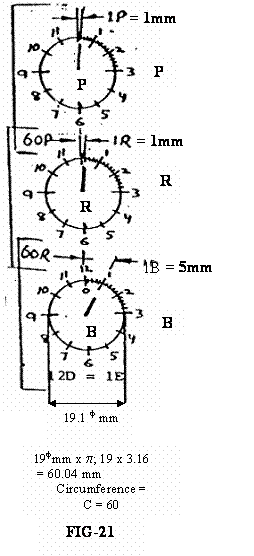
The Diameter of the Distance Pieces in Fig. 20 on page 37 is about 25mm which x p=78.5, 78.5/60= 1.309, but we want only 1 and not in addition .309. This is possible if we take a Distance Piece having a Circumference of 60 mm and then dividing it by p=19.1mm Diameter. Distance Pieces of this size have been given on Page 40, Fig.21 which has been reproduced here from page 21 Consisting of three Dials P, R & B. From Fig. 11 we see that when needle R makes a full Revolution 60 R i.e. = 1B which is E/12 or 60 mm/12=5mm.

This is shown as Needle B moving from 0 to 1 i.e. 5 divisions as by construction each division is 1mmTherefore 1B= 3600 Chkm movement of the Equator is shown as 5mm movement of Needle B on the Distance Piece. The same 1B = 3600 Chkm movement of the Equator is shown as a complete Dial Revolution i.e. 60 R= 60 mm by Needle R. These 60R/4 =15R or 15 mm movement of Needle R is also a quarter of 60mm of the full Dial movement. Seeing Page 37 Fig.20. Looking at 9B as also having 1mm Divisions on the Dial circumference, Needle B has travelled 5×9= 45mm on the Distance Piece for 3600×9=32400 Chkm by Earth’s Equator. Once again looking at the Dial of the Distance Piece showing 10B.15R. and considering the Dial  to  have  60 Divisions  and each Division  being 1mm., we have the movement of Needle B = 10x5mm= 50 mm on the Distance Piece Dial which indicates the movement of  the  Equator = 3600Chkm per B and (10B=10x3600Chkm). Also Needle R has moved 15 R and1R=60P.  As such needle B moves (1/60R x 15R) x B = ¼B = 5mm/4=1.25mm. As such the movement of      36000 + 900 Chkm =36900 Chkm by the Equator is given by the movement of  50mm +5mm/4mm+1.25mm = 51.25mm on the Distance Piece and this is also 10B of Needle B and 15 R of Needle R.

=1800 Chkm = 30R (as 1R= 60 Chkm  & 1800/60 = 30 Chkm) and this is illustrated on the Earth’s Equatorial Circumference as well as being matched on the Distance Pieces See Fig. 20. Page 37.

The Equator takes us further for a ride till we reach Basic 20 (Here one may hear some one exclaim “all these Km Travelled when I did not even step out of my House”- yes he is right about not having stepped out of his house but what he does not realize is that not only his House but the  whole City, and not only the City but the whole Country as a matter of fact the whole WORLD  has moved forward or Revolved i.e. 3600Chkm x20=72000Chkm ( =33395.832 km See Figure 20,  Page 37 ). It may not be out of place to point out here once again that this Revolutionary Movement of the Earth is with Respect (Relative) to the SUN and gives varying Temperature sensations and varying Brightness and Darkness effects such as Dawn, Dusk, Twilight, very Bright Light and Pitch Darkness. These changes of Light and Darkness and hot & cold gives us a general idea of changes in 1E (12B) or 1L (24B) and as we can’t see Stations Passing by as on a Railway Train, we Create for ourselves a Non existent, Imaginary myth and call it Time.   

This phenomena of Light and Dark, Hot & Cold is not only for the rotation of the Earth on its own axis but the Hot and cold areas that the Earth passes through during its orbit around the Sun, which depends on its distance from the Sun and also in which direction, the Earth’s axis is inclined. These factors also influence the length in Km of the Dark and Bright parts during 1L (1Length). Now if we divide 960,000,000 Km by 4 i.e. 960,000,000 ¸ 4 = 240,000,000 Km  (517,429,840 Chkm), then these 4 parts of the Earth’s Orbit around the Sun depending upon where the Earth is and the direction in which its axis is pointing, would cause varying Temperature conditions (i.e. Hot & Cold), also varying Dark and Light stretches in Km (Chkm) which would give rise to the 4 Seasons namely Spring, Summer, Autumn and Winter which are contained in 1ES = 960,000,000 Km. And one Earth’s Orbit around the Sun also contains 12 Moon Orbits around the Earth i.e.   1EO®S  contains 12MO®E   which means 960,000,000 Km ¸ 12 = 80,000,000 Km is the Orbital Distance of the Earth around the Sun for one waxing and waning of the moon i.e. for one Orbit of the Moon around the Earth.1ME  i.e. the distance the earth moves in its orbit  around the Sun = 80,000,000 Km. Earth’s movement for 1L  is therefore  960,000,000 Km / 365.25 = 2,628,336.755647 Km and the Earth’s Orbiting Distance for  1B would be 2,628,336.755647 Km divided by  24 i.e. 2,628,336.755647 Km / 24 = 109,514.0314853 Km  1LO ≈ 2,628,337Km and               1Bo ≈ 109,514 Km. So not to talk of Orbital distances of the Earth around the Sun but the distances travelled by the Earth’s Equator on its own axis gives us a feeling of change. This distance moved by the Equator is displayed by a distance moved on the so called time piece (Should be called a Distance Piece) and we exclaim “ an hour has passed” for what is actually the Distance of 5mm moved by Needle B on the Dial  See  Fig. 21 Page 40.

The Distance to Distance relationship between the Earth’s Equatorial Circumferential Distance and the Distance Piece Dial Circumferential Distance. i.e. between  the EECD and DPDCD. See Figure 20 on Page 37.

Looking at fig. 20 we notice that the Earth’s Equatorial Circumferential Distance (EECD) of 40075km = 86400 Chkm is divided into 24 equal divisions i.e. each Division  “DV” being equal to 3600Chkm. or B= 3600 Chkm. These Divisions have been numbered as 0, 1, 2,3,4,………..11,12,13,………..22,23,24= 0 (starting of a new revolution) and then again 1, 2, 3,4,…… and so on . As the Earth rotates on its axis, it moves through all these 24 Divisions. These Distances Travelled by the Equator are matched to the movement of the Needles B, R & P  (Needle P’s movement has been ignored as the Divisions are too fine for this  Fig.7 of Page 14 and Fig. 9 of page 16 may be referred to see the fine divisions of Needle P). We notice at the starting of a new Revolution of the Equatorial Distance i.e. B=0 both the needles B & R are in the perfectly vertical position, which means 24 Basics of the previous Revolutions and 0 Basics of the New Revolution coincide.  At 1B; B=1 and Needle R after having made a full Revolution of the Dial face (DF) is once again back at the previous vertical position i.e. one full Dial face (DFR-60) movement of Needle R on the Distance Piece gives 1 Basic; 0 to 1 on the Earth’s Equator.  Also Needle B moves 1/12th of the Dial Face (DFB-1/12) as shown in Dial 1B. Similarly as the Earth’s Equator turns further to 2 Basics, Needle R makes one more full Dial (DFR-60) revolution and comes once again to the original vertical Position on the Distance Piece Dial (DF) which gives another 3600 Chkm on the Earth’s Equator. Also Needle B moves 2/12 of the Dial (DFB-2/12) distance as shown in Dial (DFB-2/12).

Similarly, if we go to 9 Basics on the Equator, then Needle R would be making its 9th complete Dial (DF R-60) Revolution indicating 9 basics on the Earth’s Equator. Also Needle B would move to a position which is  (DFE-9/12) of the Dial (DF), as shown in Dial (9B).  (For symbols refer page 17)

Note: 9 One’s attention is drawn to the 24 divisions (DV) of the Earth’s Equator and that the Distance Piece has a Dial of only 12 Basics. As such, after we have reached 12 Basics on the Distance Piece, we imagine that 1 Basic of the new Dial Revolution (for Needle R) is, 12 + 1 = 13 Basics; 12 + 2 = 14 Basics; 12 + 3 = 15 Basics and so on up to 24 Basics.

Now when the Equator revolves further, the Distance between 10 Basics & 11 Basics is divided into half and then half again giving a ¼ DFR (60R¸4=15R). Here Needle R moves 10 complete Revolutions and then moves further another 15 Ranges. Needle B crosses 10 Basics and moves forward another ¼ of the Distance between 10 Basics &11 Basics, as shown on Dial 10B.15 R.

As the Earth’s Equator revolves further and reaches say 15 Basics, Needle R has completed 15 Revolutions and reaches the original vertical position. Needle B takes up position 3 Basics; as on Dial (DF) 3B (as 3 is 3 more than 12 i.e. [12+3=15]) as shown on Dial (DF) 15B. The Equator revolves further till (WE BY RIDING ON IT REACH) 16 Basics; here again the Distance of B = 3600Chkm between 16 Basics & 17 Basics and the equator is divided into 4 parts i.e 900 Chkm or = 15R (as 1R=60 Chkm & 900/60=15 Chkm) and the Needle R on the DISTANCE PIECES (LYING ON SHELVES HANGING ON WALLS, STRAPPED ON TO OUR WRISTS) would have made 16 complete Revolutions and moved forward 15×2=30 Ranges, whereas Needle B would travel ½ the Basic between 16 and 17 (i.e. 4 & 5 on the distance piece) on the Equator i.e. 3600/2