Further it may be noted that the New Concept does not conflict in any way with Max Planck’s or Einstein’s theories but rather accommodates them.
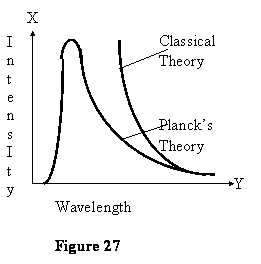
In 1900, Max Planck developed a formula (his analysis led to a curve see Fig. 27) for blackbody radiation i.e. En = nhf where n is a positive integer called a quantum number and f is the frequency of vibration of the molecules. The factor h is a constant, known as the Planck’s Constant, given by- h = 6.626 x 10 -34 J. s [ see C.P. Page 915]. So looking at this formula, we see that the New Concept leaves n, the positive integer, unaffected. Frequency ‘f ‘ is the number of cycles or vibrations per unit time.
From above it is observed that the unit of time being used here is a second. So according to the New Concept, Frequency would be- ‘ f ‘ is the number of cycles or vibrations per Portion. [See 44 & 45]. Also in
6.626 x 10 – 34 j. s we see that 6.626 x 10 -34 remains unaffected by the New Concept; so we are now left with j. s, here again, ’s’ becomes ‘ P’ and finally we are left with j (Joule) which is a unit of Work in the SI System . A Joule, i.e. j = N. m, is a Newton – meter. A Newton is defined as 1N = 1kg.m/s 2 [see page 80 a (4.3) Page 110 C.P.). Therefore j. s = Newton meter .s = 1kg.m/s 2.m s = 1kg m2 /s , which, according to the New Concept would be 1kg (1 ¸ 463.831) Chm2/P. As such, Planck’s constant according to the New Concept, would read as –
h = 6.626 x 10 -34 1kg ( 1 x 463.831 Chm) 2 /P
Note: – (18) The Speed of Light in Vacuum is c » 3.00 x 10 8 m/ s [see Physical Constants C. P.]. As per New Concept it would be c » [ 3.00 ¸ 463.831 ] x 10 8 Chm/P
Einstein modified and reinterpreted the work of Planck to show that the Energy of a photon is proportional to the frequency of the electromagnetic wave i. e. Energy of a photon is given by
E = h f.
Energy is the ability or capacity to do work. And Work = Force x Distance, also Force = Mass x Acceleration. Acceleration is the rate of change of velocity.