Constructing a Distance Piece (Continued)

Having a Dial with 12 main divisions and each main division is further divided into 5 sub-divisions and each sub-division=1mm (Standard mm as a Chotu mm will make too small a Dial) Such that the Dial Circumference would be (on which the longest Needle P’s tip would move) = 12×5=60mm and the Diameter of the Dial would be =60¸p=19.0985 » 19.1mm i.e. C=60mm (Circum.) & D=19.1f mm (Dial.) Three Dials for Needle movements.

P, R & B have been shown on the Right while on the Left we have the Diagram of the Earth with the Equator divided into 24 divisions which are in Chotu Km i.e. each Division (DV) is a Basic (B) = 3600 Chkm which is represented by  1/12 Dial = 60mm/12 =5mm on the DFB , One complete Dial = 60 mm on DFR and  = 60 Dials x 60mm = 3600mm on the DFP. ( For symbols refer page 17 )

2 ).  Chotu Kilometers ( Note: -3)

Distance

  1. P.  Pg.3 Para. 3 Length – “This standard prevailed until 1799, when the legal standard length in France became the meter, defined as one ten millionth of the distance from the Equator to the North Pole”, which is the same thing as 1/10,000,000m the distance between the Equator and the North Pole i.e. 10,000,000 meters, or divided by 1000 =10,000 km.

As per our definition here it makes more sense to relate the meter to the Equatorial Circumference; the Earth’s Equatorial circumference has been given as 40075 km which does not let itself to be properly divided by 86400parts. This is possible only when one introduces  1 CHOTU KILOMETER, the length of 40075/86400 = 0.463831 km. (The CHOTU’S value can be calculated to any degree of accuracy.  The CHOTU can be measured according to the scientific advancements with the wavelength of orange-red light emitted from a Krypton-86 lamp. Or by the distance travelled by light in vacuum.)

Until recently, the meter was defined as 1,650,763.73 wavelengths of orange-red light emitted from a krypton-86 lamp. However, in October 1983, the meter was redefined to be the distance travelled by light in a vacuum during a time of  1/299,792,458=3.335640951982e-9 » 0.00,000,000333 seconds.  In the case of a Chotu meter it would be the distance travelled by light in vacuum during the Distance of 

0.00,000,000333 ¸0.463831 =7.179339026498e-9 » 0.00,000,000,718 Portions (1 Portion will be = 1mm travel of Needle P on the Dial see Page 14, Fig.7) In effect, this latest definition establishes that the speed of light in a vacuum is 299,792,458 meters per second. So the speed of light in vacuum is then 299,792,458 ¸ 0.463831 » 646,339,847.9187 Chotu meters per Portion.

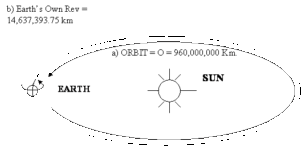
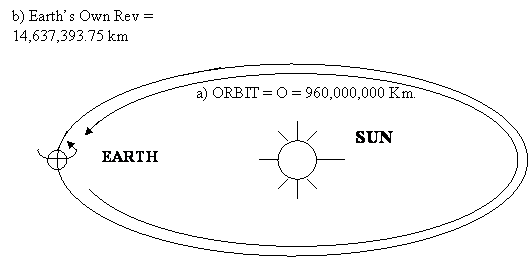
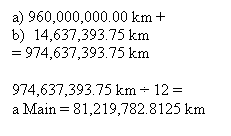
Earth’s Orbit around the Sun: E O® S  = 960,000,000 Km

365 ¼ Earth’s Revolution about it self = 40075 Km x 365.25 = 14,637,393.75 Km.

1 Light Orbit – is the Distance a Light Ray would Travel – when the Light Ray Begins its travel and the Earth is at a particular Point in its Orbit around the Sun and the Destination that the Light Ray reaches after the Earth Completes one full Orbit

(= 960,000,000 Km) and returns to Exactly the same particular Point. See Pg.6, Fig.1

      Notation

O                     =    Orbit

Mo                          =    Main

86400 Chkm    =   L  ( Length )            2E        =   L  =  86400   Chkm

L/2                   =   E  ( Extent ) 12B     =   E  =  43200   Chkm

E/12                 =   B  ( Basic  ) 5M      =   B  =    3600   Chkm

B/5                   =   M ( Measure )         12R     =   M =      720   Chkm

M/12                =   R  (Range )             60P      =   R  =        60   Chkm

R/60                 =   P  ( Portion )           1P       =                     1  Chkm

1P                    =   1  Chkm

Constructing a Distance Piece

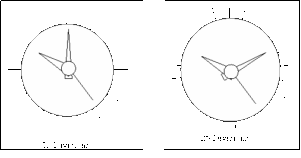
A 25 division distance piece using Lambu Km instead of the usual Km side by side with a normal Timepiece.

Fig : 4                                                              Fig : 5

Usual Time Piece                                             Suggested Distance Piece

With 12 Divisions                                             with 25 Divisions

i.e. Half a day or                                               i.e. Full Day with 25 Hours

12 Hours double this

is 24 Hours i.e.             1 Day

40,075 Km                  = 40,000 Lkm                          Causes 24 Hr’s *

20,037.5 Km               = 40,000/2 = 20,000 Lkm        Causes 12 Hr’s *

1,669.79169 Km         = 40,000/25 = 1600 Lkm         Causes 1 Hr *

27.82986 Km              = 1600/40 = 40 Lkm                Causes 1 Minute *

0.463831 Km              = 40/40 = 1Lkm                       Causes 1 Second *

1). Lambu Kilometers

Earth’s Equatorial circumferential Distance=EECD  = L = 40,075 Km ¸ 40,000 division = 1.001875 Km. This gives us the LAMBU Km such that 1 Lambu Km = 1.001875 Km, so that when we multiply 40,000 by 1 Lambu Km we get the original L = 40,075 Standard Km .And also:-

40,000 LKm                                                                                            = 40,075 Km

40,000 LKm  ¸ 25                                                                                  = 1600 LKm cause a Lambu hour *

1600 Lkm  ¸ 40                                                                                      = 40 LKm cause a Lambu minute *

40 LKm ¸ 40                                                                                          = 1LKm cause a Lambu second  *


1600 LKm                                                                                               = 1603 Km

40,075 Km ¸ 24                                                                                      = 1669.7916 Km » 1670 Km cause a

standard hour *

Now taking 1670 Standard Km moved by earth’s equator in        = 1hr

1Km moved by earth’s equator in                                                     = 1/1670 hr

\1603Km moved by the earth’s equator in                                     = 1/ 1670 x 1603  = 0.9598 » 0.96 hr

 And 0.96 hr x 60                                                                                   = 57.6 = 57’ .36” which means that

our Lambu Hour

(Basics) is 2’ 24” shorter then a

standard hour *.


40 LKm                                                                                                   = 40.075 Km

1670 Km ¸ 60                                                                                         = 27.8333Km » 28 Km cause a

standard minute *

Now taking 28 Standard Km moved by the earth’s equator in     = 1min

1Km moved by earth’s equator in                                                     = 1/28 min

\40.075 Km moved by the earth’s equator in                                 = 1 /28 x 40.075  = 1.431min

»1.43 Minutes * which means that

our Lambu minute

(Range) is 0’. 26”greater then

standard minute *.


1LKm                                                                                                      = 1.001875 Km

28 Km ¸ 60                                                                                             = 0.4666 Km ≈ 0.5 km. cause a

Standard second

Now taking 0.5 Standard km moved by earth’s equator in            = 1 sec

1Km moved by the earth’s equator in                                              = 1/ 0.5 sec

\1.001875 Km moved by earth’s equator in                                   = 1/ 0.5 x 1.001875    = 2.00375 » 2 sec

2 second which means that our Lambu

second     

*(Portion) is 1” second greater then a

standard second *


Equatorial Distance                                                            40075 Km=40000LKm

40,075 Km x 30                                                                      =1202250 Km causes a Month (O® E)

40,075 Km x 365.25                                                               =14637393 Km causes a Year (O® S)

40,000 LKm x 30                                                                    =1200000 LKm causes a Lambu Month (O® E)

40,000 LKm x 365.25                                                             =14610000 LKm causes a Lambu Year (O® S)

Orbital Distance around the Sun                                     =960,000,000 Km

960,000,000 Km                                                                     =958,203,369 Lambu Km


Foot Note

*These Lambu Kilometer distance moved is compared to the imaginary and nonexistent Year, Month, Days, Hour, Minutes and Seconds. This is only to give the reader an idea, but, this comparison has no real value as in reality, time does not exist.

Note1 The speeds given under the heading of the Universe ( See Page 5) are in miles per Hour, also the Energy/Mass  ( matter )  given out has  been expressed  as discharged per Second  over billions of Years  !!!

But as you now know there is no such thing as TimeAs such the speeds will be in miles per Basics and not per hour. Also the discharge will be per portion and not per second. (as  under Chotu Miles shown in the above  table; see Page 9 ).  Finally it will be for billions of Orbits and not billions of years, WHICH ARE UNITS OF DISTANCE and not time.

It may be interesting to observe that Orbit, Length, Basic, Range, Portion are from our Solar system  (same as was in the case of the non-existent and imaginary Year, Day  {24 hours} Hour, Minute and Second)

Note:- 2  This  leads one to think of having a DISTANCE PIECE instead of a time piece whereby the distances  (Traveled by) of the Earth’s equatorial circumference (Relative to the Sun) are directly transferred and represented on the distance piece dial. This transfer is without having time intrude between the EECD   (=L) and the Dial of the distance piece, which is a Distance to Distance Relationship. We see later in this book the construction of such a Distance Piece.

3)   So let us now once again go back and think of the Earth rotating in front of the Sun.

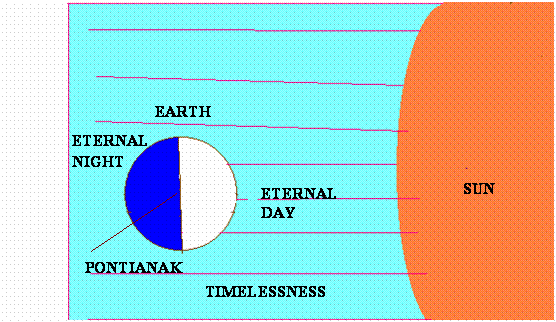
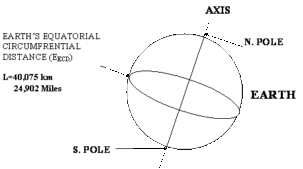
      Stopping the earth’s rotations is only a passing argument as we all love Sunrises and Sunsets and would not like the earth to stop rotating. We love light while facing the Sun and darkness when we are on the other side of the Earth away from the Sunlight. We love to see the Moon and the Stars and to be able to rest and sleep in the darkness of the night. However, this argument is necessary to illustrate that time does not exist and only distance exists.  As there is no time, there would be no Timepieces.  We now have a distance of L= 40,075 Kms. (24,902 Miles) revolving in front of the Sun from one Sunrise at PONTIANAK to another Sunrise As there is no time, we therefore would have to construct Distance Pieces. For this we would have to divide the distance of L= 40,075 Km into a suitable number of divisions.  There can be innumerable ways of dividing the distance of 40,075 Kms. Here of course we make four selections. See table given below.

Earth’s Equatorial Circumferential Distance = 1 Length = L = 40,075 Kms.

S.No Length

(L)

Basic

(B)

Range

(R)

Portion

(P)

Kilometer

(Km)


1 40,075 Km L ¸ 25 = 1B

= 1603 Km

B ¸ 40 = 1R

= 40.075 Km

R ¸ 40= 1P

=1.001875 Km

Lambu  Kms

1P= 1Lambu.km


2 40,075 Km L ¸ 24 = 1B

=1669.7916 Km

B ¸ 60 = 1R

= 27.82986 Km

R ¸ 60 = 1P

=0.463831 Km

Chotu Kms

1P= 1 Chotu.km.


3 40,075 Km L ¸ 28 =1B

=1431.25 Km

B ¸ 70 = 1R

= 20.446428 Km

R ¸ 70 = 1P

=0.2920918 Km

Nicku Kms

1P= 1Nicku.Km.

4 40,075 Km L ¸ 20 = 1B

=2003.75 Km

B ¸ 100= 1R

=20.0375 Km

R ¸ 100 =1P

= 0.200375 Km

Atichinna

1P= 1Ac.Km


 Chotu Miles

S.No Length

(L)

Basic

(B)

Range

(R)

Portion

(P)

Chotu Miles
2* 24,902 miles L¸ 24 =1B

=1037.583 Miles

B ¸ 60 = 1R

= 17.29305 Miles

R ¸ 60 = 1P

=0.2882175 Miles

1P = 1Chmile


We say that one Sunrise to another Sunrise at PONTIANAK is 24 Hours. Further, each Hour is divided into 60 minutes and each minute into 60 seconds i.e. 24x60x60 = 86,400 seconds (the basic unit of Time).

                                                                Figure 3

2)  Earth Stops Rotating in front of the Sun

            Let us now put it to the Acid test and according to the law of the survival of the fittest – think that the Earth stops rotating in front of the Sun. This would mean there would be an eternal Sunrise at PONTIANAK. This would also mean (see Fig. 3) that Half of the Earth facing the Sun would be for ever and ever in the Sunlight and as such have everlasting day whereas the other Half of the Earth away from the Sun would have eternal night. This eternity means 24 hours, 60 minutes, 60 seconds would cease to exist. As such, time would disappear! Or we could say that this Discovery would mean the end of the (survival) concept of Time. But according to the law of survival of the fittest the Equatorial Circumferential distance of: L= 40,075 Kms (24,902 Miles) would remain (survive).

INTRODUCTION

“TIME & SPACE DO NOT EXIST -ONLY DISTANCE  EXISTS”

Till now, man has lived with time which is purely a fictitious and imaginary creation of his mind. In this book, it is shown that there is no such thing as time or space, which are non-existent, and the only thing that really exists is distance. This book, using scientific measurements and arguments, proves that time does not exist. It further goes on to discuss how we can create “Distance Pieces” as a way to measure our lives and existence with respect to the distance the earth travels (with us riding on it) relative to the sun.

  Figure 2

1)   Earth rotating in front of the Sun

      The Sun rises at PONTIANAK in Borneo Indonesia, (see Fig. 2) which lies almost on the Earth’s Equator. The Equator rotates (see Fig.1) one full revolution, having a DISTANCE of 40,075 Km (24,902 miles), about its own Axis, carrying PONTIANAK from one Sunrise to another. This revolutionary movement of the earth is with respect (relative) to the sun and gives varying Temperature sensations and varying Brightness, Shades and Darkness effects such as Dawn, Dusk, Twilight, Very Bright Light, and Pitch Darkness. These changes of Light and Darkness , Hot and Cold give us a general idea of changes in 1E (12B) or 1L (24B) (see Page 13).As we can’t see stations passing by (as we would were we taking a journey by train) we Humans let our imaginations run riot, and create for ourselves, or introduce a non-existent, fictitious intruder  (impostor) i.e. an imaginary myth as a way of explaining these changes and call it TIME.

Figure 1       From our Solar System

PROLOGUE

SOME FACTS ABOUT OUR UNIVERSE AND THE SOLAR SYSTEM

Rushing through the Universe at the incomprehensible speeds of!!! and the  enormous amount of Energy/Mass thrown out by the Sun in to Space!!!

1)      The earth’s speed at the equator = 1,040 mph. ( See Page 10 ).

2)      The earth is moving through its orbit around the sun at 66,661 mph.

3)      The sun is carrying itself and its planets towards the star Vega at about 43405.8 mph.

4)      Our sun and Vega moves around the galaxy at the blinding speed of 700,000* mph.

5)      And our galaxy (the Milky Way) itself rotates at 559,353.6 mph.

6)      But that is not all. Our galaxy moves in relation to all other galaxies as they rush through the universe at a speed of more than 1,000,000* mph.

  1.      1,040
  2.     66,661
  3.      43405.8
  4.    700,000*
  5.     559353.6
  6. 1,000,000*
  7. 2,370460.4

Incredible speeds of :

Thus, as we stand here on earth, and one may get the impression of being relatively inertial, we in reality are travelling at the incomprehensible speed of approximately 2.5 million miles per hour in the resultant of six wildly different directions simultaneously. And all this is happening in real time – here and now.

Enormous amount of Energy/Mass given out by the sun per second:

Our sun  – what a powerhouse! I still don’t believe it. During all the billions of years that it has been in existence, it has thrown into space six million tons of matter every second. And it can go on doing it for another ten billion years without using even 1/100th of 1% of its mass.

* – unverified